Creating space for collective change: Reflections from the facilitators
by Rasha Abdel Latif & Rajae Boujnah
We were fortunate to cross paths once again and bring our collective energy, experience, and most importantly our shared passion into a space dedicated to Yemeni civil society actors. At a time when Yemeni civic space continues to shrink, risks are intensifying, and uncertainty around protection and funding remains constant, convening in this way felt both necessary and urgent.
 The Voices for Justice: Inspiring Pathways for Change conference was designed with intention. We did not aim to raise awareness of realities that participants already know intimately. Instead, we invited those who have spent years navigating this complexity, actors who could reflect on hard-earned achievements, question assumptions, and imagine pathways toward justice and peace that are grounded in lived experience.
We knew that bringing this level of capacity into one room would not result in polished statements that sound good in the moment but dissolve once participants return to their contexts. What it would generate, we believed, was something far more valuable: renewed hope, shared ownership, and the confidence that resilient, collective thinking can lead to real change.
Working with complexity
Justice and accountability work in Yemen is inherently complex. It moves quickly, is shaped by regional and international dynamics, and unfolds under constant risk. Complexity demands methods that can hold uncertainty, test assumptions, and generate ideas that are both creative and applicable.
This is where design thinking proved relevant. By combining co-design and foresight into the conference journey, we created space to explore multiple futures, stress-test ideas, and continuously iterate on what could realistically work.
Design thinking gave us a way to avoid rushing to solutions. The Double Diamond , a simple map of the process: we first open up to understand the problem properly (diverge), then narrow down to what matters most (converge). We open up again to generate and test options (diverge), then narrow down to what is feasible and worth committing to (converge). It’s a way to slow down early so the insights later are stronger.
Rather than searching for immediate answers, participants were encouraged to understand the problem deeply, analyze it collectively, and gradually narrow focus toward what truly matters.
Collective intelligence in practice
Co-design only works when roles are flattened. We deliberately moved away from the familiar conference model where a few voices dominate, and others react. Instead, the room was structured to rely on each participant’s perspective, recognizing that expertise in this space is collective.
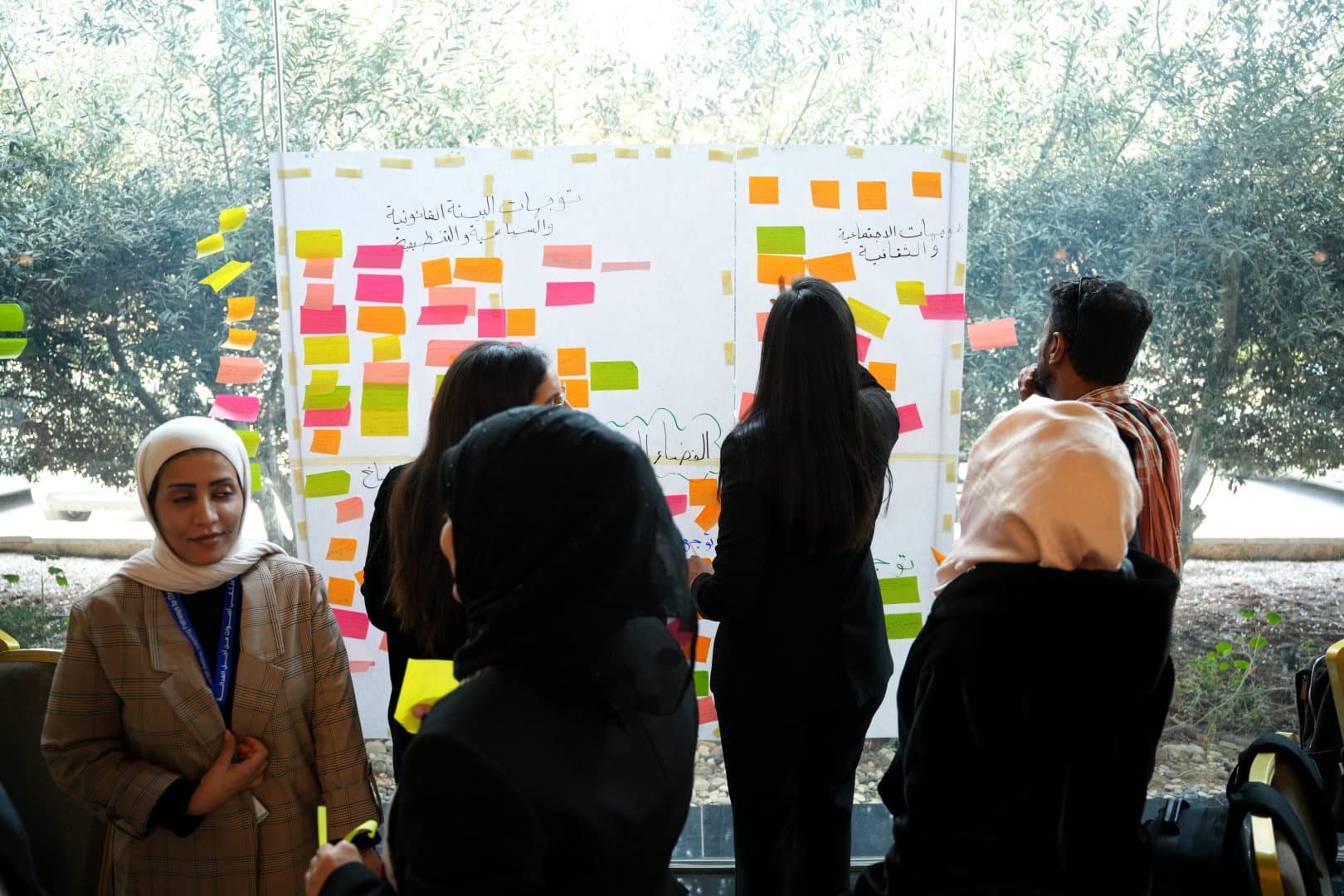
 The co-design process became a microcosm of society itself. Assumptions were challenged as participants built alongside survivors, implementers working with minimal resources, advocates, documenters, political analysts, and community leaders. Each held a piece of the system. Together, they practiced listening, adjusting, and owning trade-offs while building patience with temporary ambiguity and responsibility for shared outcomes.
One of the most powerful outcomes of the conference was the ability to rigorously test ideas without making discussions personal. Participants watched their concepts evolve or fall apart through sense-making and methodological tools, while their contributions remained protected. This created an environment where thinking could deepen without defensiveness.
From ambition to actionable pathways
We also stayed patient with ambiguity. In civil society work, “clarity” that comes too early is often expensive later. Rather than rushing to solutions, the process guided participants through understanding the problem, mapping scenarios, identifying early warning signals, and integrating risk management into solution development. This pushed the group beyond the rearview mirror and toward designing for plausible futures, not just familiar ones.
Our role as facilitators was to orchestrate rather than direct to set the stage, invite participation, consolidate insights, and make experimentation possible. Often, that meant stepping back and allowing the group to build, intervening only to support the process when needed.
The outcomes spoke for themselves. Clear priorities emerged, thematic pathways were defined, and practical solutions were shaped by those who will carry the risks and responsibilities forward. Methodologically, the conference reaffirmed something we strongly believe; co-creation and foresight do not simply make gatherings more interactive, they significantly improve the quality of thinking. They help shift conversations from ambition to conditions, and from individual positions to shared responsibility.
Looking ahead
We would not have done this differently. The experience was both humbling and energizing, and we are deeply grateful to have shared space with such committed and courageous Yemeni actors. We remain committed to sustaining this momentum and facilitating follow-up roundtables to further develop and act on the conference findings.
We invite you to explore the detailed outputs from Voices for Justice: Inspiring Pathways for Change on our website to learn more about the themes discussed and the pathways identified.